
数据十诫(3)
- 車品覺
- Jan 1, 2021
- 3 min read

Updated: Apr 28
原文来自决战大数据升级版(第一章)
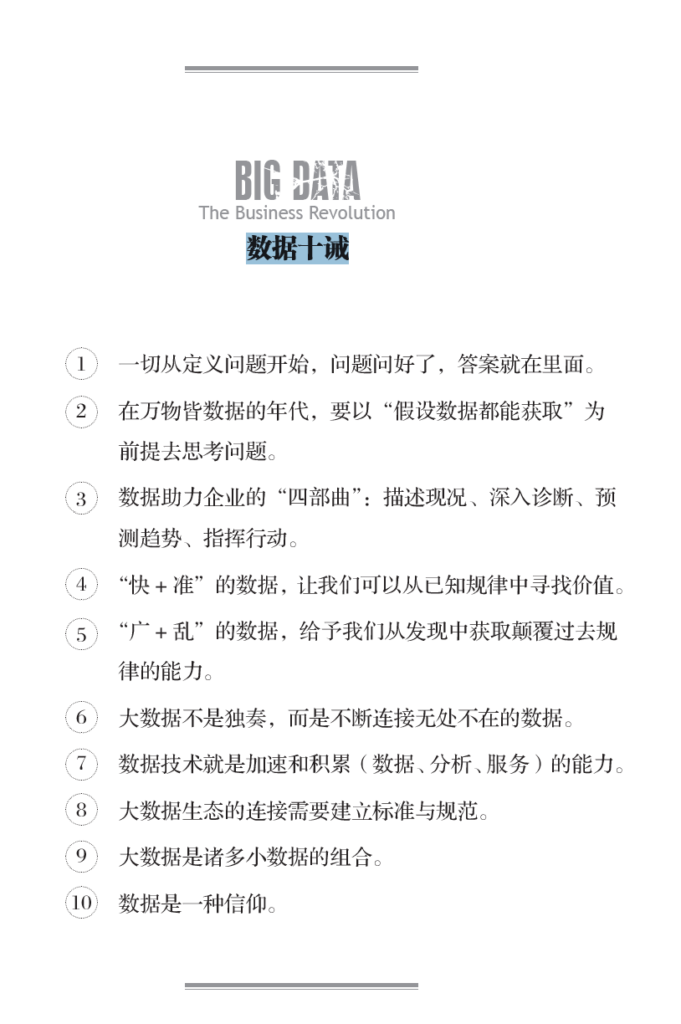
数据十诫有的灵感来自老師的笔记。特别是十诫中的第二条,假设数据都可以被获取去思考问题,对我于其有启发。在我的大数据路上,十诫有几个不同的版本,其实都是为了方便自己总结经验。十年过后的今天(2021年)发觉其中有数条原则还是历久常新。
下面是老师(Andreas Weigend)英文笔记的原文部分,为了不改变原意所以我不作翻译:
10 Commandments (其中前三条)
Mindset is key in the data revolution!
1, Start with the problem, not with the data
PHAME Empowering to actually do it
2. Share data to get data
Market structure / Free rider Creative economics
Data promiscuity / Most smart ppl don’t work here
Liberate your data
3. Align interests of all parties
This is the only thing that works in the long termExample: Google adwords: Ads are ranked by expected revenue for Google, creating an incentive for advertiser to be good (if the text is awesome, google shows the ad higher up on the page since it is more people will click on it)Incentive alignment more powerful than legal contracts
VIP Content below :
Mindset is key in the data revolution!
1, Start with the problem, not with the data
PHAME
Empowering to actually do it
2. Share data to get data
Market structure / Free rider
Creative economics
Data promiscuity / Most smart ppl don’t work here
Liberate your data
3. Align interests of all parties
This is the only thing that works in the long term
Example: Google adwords: Ads are ranked by expected revenue for Google, creating an incentive for advertiser to be good (if the text is awesome, google shows the ad higher up on the page since it is more people will click on it)
Incentive alignment more powerful than legal contracts
4. Make it trivially easy for people to contribute, collaborate, and connect with each other
to genuinely contribute and make sure they experience the positive effect of truthful data
Take whatever you can get
More expensive to decide what to delete rather than to simply storing everything
BI: Based on structured and clean data
Super-noisy data needs a different mindset than financial reporting
“Don’t worry, be messy”
Become part of your customer’s digital life / lives
5. Develop a sound customer identity strategy
Most likely build on identity already created elsewhere: such as Mobile phone number, Gmail, Facebook
Treat people as individuals, not as members of a segment
Now feasible, think all the traces we leave
Also, people want to be (recognized as) individuals (FB, weibo – self expression)
6. Base the equation of your business on customer centric metrics
And evaluate against them all the experiments and variations
7. Decompose the business into its “atoms”
Communication economics à Ubiquitous communication and atomization
Incl human cloud is efficiently possibly at scale
Innovation without people who tell you why it can’t be done since someone else did something else in the past that failed
Politics and power in bundled systems vs loosely coupled parts
8. Embrace transparency
information symmetry
Those who remove information asymmetries make money
9. Though shalt not blame technology for barriers of instituaions, culstures and society
Address the culture of your company and norms of society, notyesterday’s
When things are digital, there is no excuse for data not traveling
Barriers in the past indeed often were of technological nature, but progress has been amazing, so the main barriers now often are the culture of the institution or norms of society
10 Let people do what people are good at, and computers what computers are good at
Ex: metadata created by the author (vs machine learning)


